
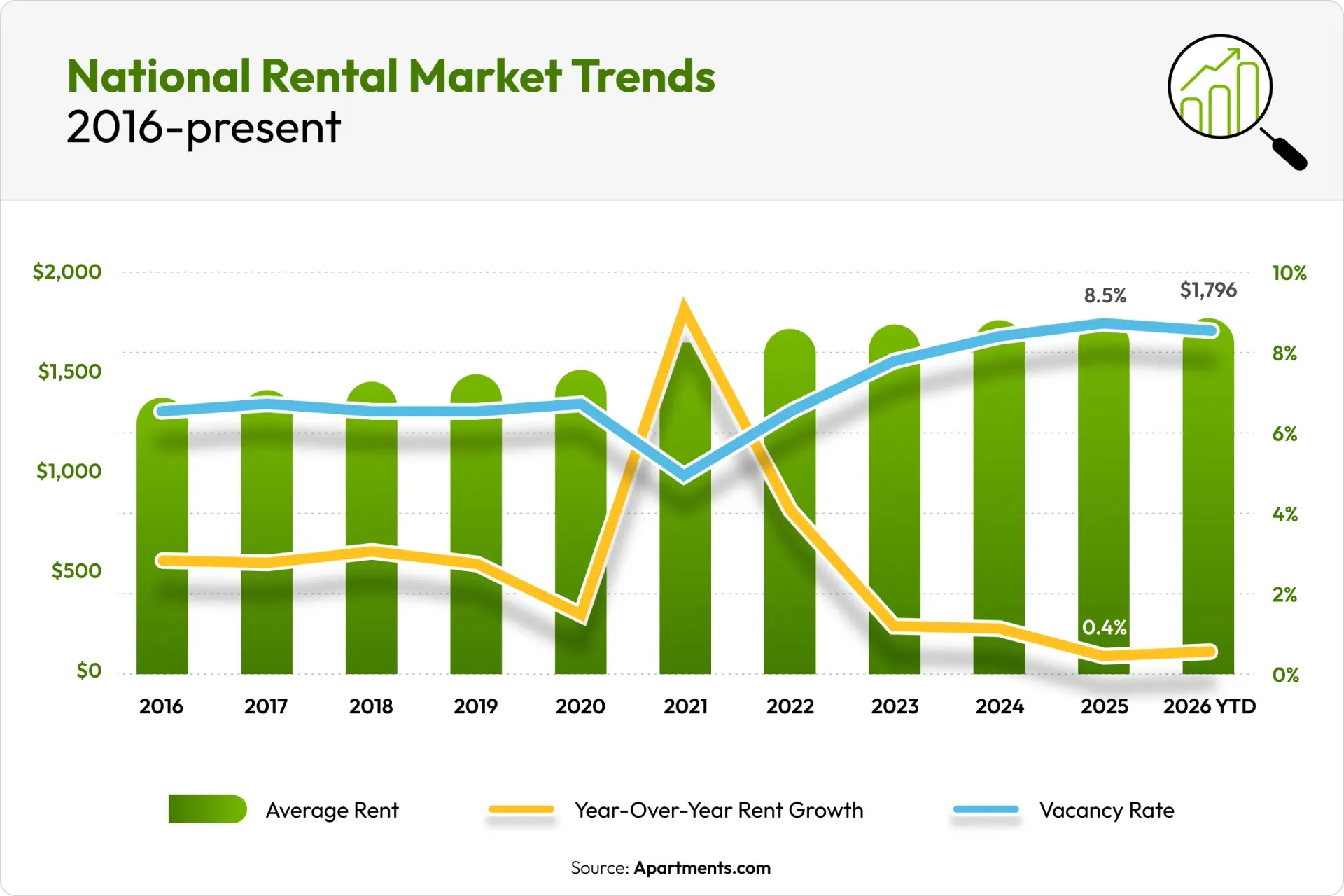
What is the current state of the rental market in June 2026? The graph above from Apartments.com shows how vacancy rates are on the rise, while rents growth has been in a steady decline since 2021. As of June 2026, rents are staying flat with only a 0.04% increase over the past year.
With that in mind, one of the most common questions we get from rental property owners is, “How long should we wait before lowering the rent?”
There is no single answer that applies to every property, but after managing roughly 1,200 rental units, we can say this with confidence: the market usually gives you clues. The key is paying attention to those clues before a short vacancy turns into an expensive one.
At Candlewood we look at a combination of factors, including showing activity, inquiries, competing properties, renter feedback, time on market, and overall demand.
Here are some of the biggest signs that a rent adjustment may be worth considering.
Lots of Views, but Very Few Inquiries
If a listing is getting plenty of online views but very few people are reaching out, the price may be stopping renters before they ever schedule a showing.
That does not automatically mean the rent is too high, but it is one of the first things we look at.
Plenty of Showings, but No Applications
This can be an even stronger signal.
If renters are seeing the property in person and repeatedly choosing something else, the market may be telling you that the apartment is not competitive at its current price. It's telling you that renters are not seeing the same value that they are seeing in other rentals.
Again, price may not be the only issue. Condition, location, parking, utilities, layout, and amenities all play a role.
But if the property has been shown several times with no strong interest, it is usually worth taking a closer look at pricing.
Similar Properties Are Renting Faster
Owners sometimes focus on what another apartment is listed for, but asking rent is not the same as actual market rent.
A neighboring apartment may be listed at $1,100, but that does not mean anyone has actually rented it at that price. It could be over priced and sit vacant for two months.
We care much more about what comparable properties are actually renting for and how quickly they are moving.
The Property Has Been Sitting Too Long
Every day of vacancy has a cost. For a $1,000 apartment, each vacant day represents roughly $33 in lost rent.
-Fifteen days of vacancy costs around $500.
-Thirty days costs $1,000.
-Sixty days costs $2,000.
That is why timing matters. Dropping rent by $50 after the property has already sat vacant for 60 days does not recover the $2,000 that was already lost.
In many cases, a smaller and faster adjustment is financially better than waiting too long and making a larger adjustment later.
Listen to the Market, Not Just the Asking Price
We never recommend lowering rent simply for the sake of lowering it. The goal is to make informed decisions based on real activity.
Sometimes the right move is to stay firm. Sometimes the property simply needs more time. Sometimes better photos, improved marketing, or small property updates can make the difference.
When the market consistently tells us that renters are not willing to pay the current price, ignoring that information can become expensive.
In Part 3, we will look at one of the biggest mistakes landlords make: assuming rent should always increase simply because it increased in the past.