
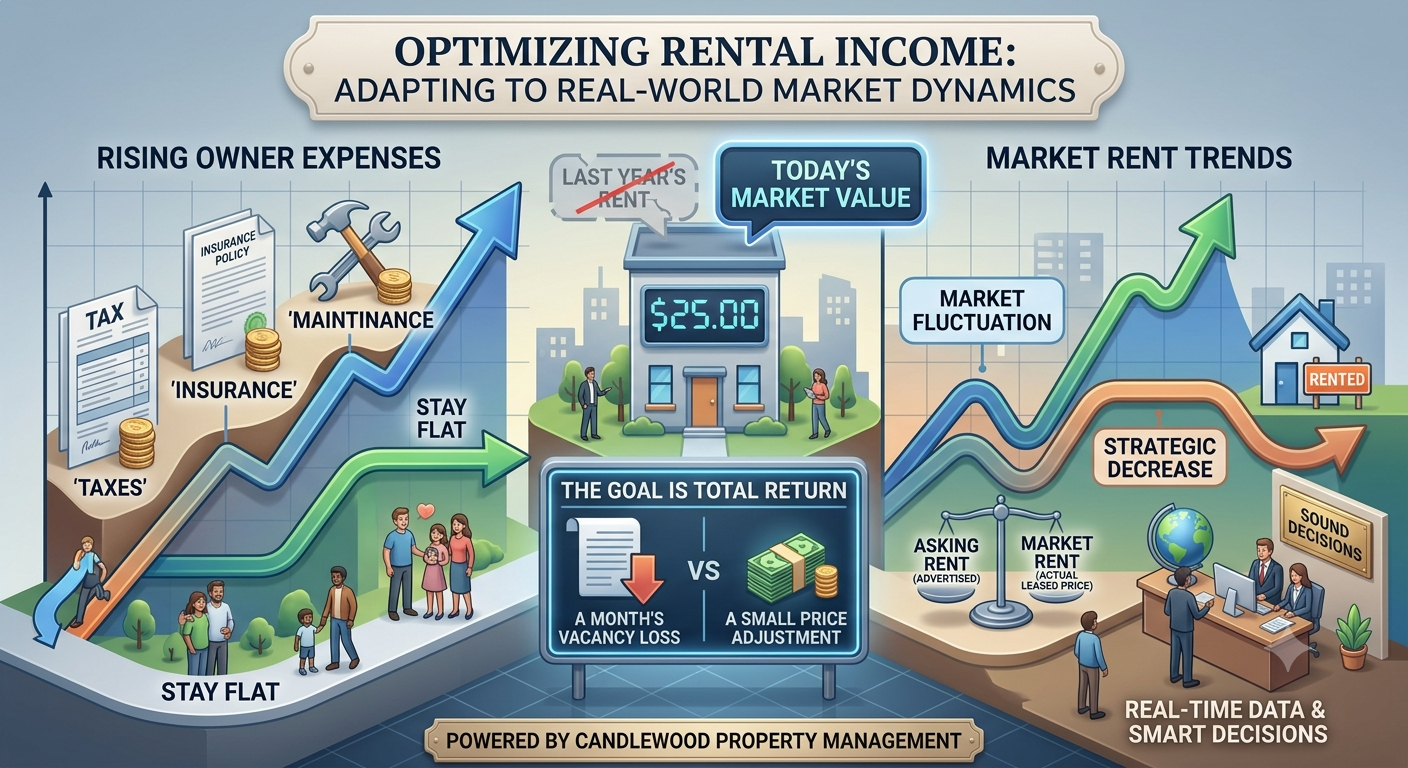
For many landlords, there is an expectation that rent should increase every year, and it is easy to understand why.
Property taxes go up. Insurance goes up. Labor and material costs go up. Repairs get more expensive. Naturally, owners want rental income to keep pace, but the market does not always work that way.
At Candlewood one thing we see again and again is that market conditions can change quickly. A property may support a rent increase one year and need to stay flat the next. In some cases, it may even make financial sense to lower the rent slightly to avoid extended vacancy. That can be difficult for an owner to accept, especially when the property previously rented for more.
But last year’s rent does not determine today’s market value.
The Market Does Not Care What the Rent Used to Be
One of the most common things we hear is, “But it rented for $1,000 before.” That is understandable, but the real question is whether a qualified renter is willing to pay $1,000 today.
If similar properties are available for $950, or if renters now have more choices, then holding out for last year’s rent can cost more than adjusting to the current market.
The same applies when an owner says, “My taxes went up, so the rent needs to go up too.” The stark reality is that renters do not choose apartments based on the owner’s expenses. They compare the property with other available options and decide what they believe it is worth.
Do Not Confuse Asking Rent With Market Rent
An apartment listed for $1,100 does not mean the market rent is $1,100.
-The property may sit vacant.
-The owner may offer a free month.
-They may reduce the price two weeks later.
-They may accept less than advertised.
The most useful comparison is not what other landlords are asking. It is what renters are actually willing to pay. That is why good pricing requires looking at the full market, not just one or two competing listings.
The Goal Is Total Return
This is the point we come back to most often with owners. The goal should not be to win on monthly rent. The goal should be to maximize the overall financial performance of the property.
For a $1,000 apartment, losing one month of rent costs $1,000. A $50 monthly rent reduction costs $600 over the course of a full year.
So if lowering the rent by $50 avoids a full month of vacancy, the owner actually comes out ahead. That is not always the right move, but it is an example of why landlords need to think beyond the monthly number.
Good Property Management Means Adjusting With the Market
The strongest owners are not the ones who always push rent higher. They are the ones who make smart decisions based on actual market conditions.
Sometimes that means increasing rent.
Sometimes it means keeping rent flat.
Sometimes it means making a quick adjustment to protect the property’s annual return.
At Candlewood, our job is not simply to chase the highest possible asking rent. Our job is to help owners make sound decisions based on real market activity, current demand, vacancy costs, and the long-term performance of the property.
Because at the end of the day, the highest advertised rent means very little if the apartment is sitting empty.